

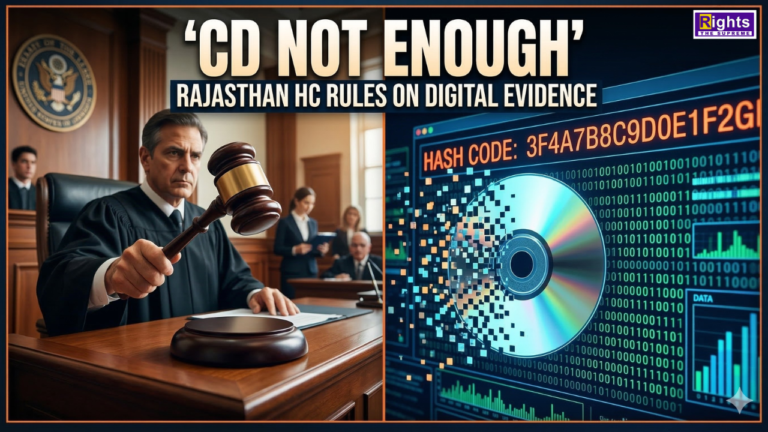
In a significant and progressive development in Indian criminal jurisprudence, particularly in the domain of electronic evidence and corruption-related prosecutions, the Rajasthan High Court has delivered a landmark judgment that reinforces the constitutional mandate of a fair trial. The Court has categorically held that where the prosecution seeks to rely upon electronic evidence—such as audio or video recordings—it is under a legal obligation to furnish to the accused not merely a copy of such evidence, but a certified clone copy accompanied by its hash value.
This judgment marks a crucial step in addressing the growing complexities associated with digital evidence admissibility, authenticity, and forensic reliability, especially in trap cases instituted under anti-corruption laws. The Court unequivocally stated that providing a mere compact disc (CD) does not satisfy the procedural and constitutional requirements imposed upon the prosecution.
The ruling was rendered by the Single Bench of Justice Baljinder Singh Sandhu, while adjudicating a petition filed by one Kishan Agrawal, who challenged the refusal of the trial court to grant access to complete electronic evidence in a verifiable form.
Context and Legal Significance of the Judgment
The importance of this ruling lies in its direct engagement with the evolving nature of evidence in the digital age. With increasing reliance on electronic recordings, surveillance devices, and digital storage media in criminal investigations, courts are often confronted with questions regarding the authenticity, integrity, and admissibility of such materials.
Unlike traditional documentary evidence, electronic records are inherently susceptible to manipulation, duplication, editing, and tampering, often without leaving visible traces. Therefore, courts have increasingly emphasized the necessity of forensic safeguards to ensure that such evidence withstands judicial scrutiny.
In this context, the concept of a hash value assumes critical importance. A hash value functions as a unique digital fingerprint of an electronic file. Even the slightest alteration in the file results in a completely different hash value, thereby enabling detection of tampering. Similarly, a certified clone copy refers to an exact, bit-by-bit reproduction of the original digital data, verified and authenticated through forensic processes.
By mandating the supply of both these elements to the accused, the High Court has reinforced the principle of equality of arms, ensuring that the defence has a fair opportunity to challenge the prosecution’s evidence.
Factual Background: The Trap Case and Disputed Recording
The case arose from proceedings initiated under the Prevention of Corruption Act, 1988, involving allegations of demand and acceptance of illegal gratification. According to the prosecution, incriminating conversations between the accused and the complainant were recorded using a digital voice recorder during a trap operation.
These recordings formed the foundation of the prosecution’s case.
However, the accused raised serious objections regarding the manner in which the electronic evidence was being handled. It was contended that:
The prosecution had supplied only a dubbed version of the recording in the form of a CD.
No certified clone copy of the original recording was provided.
The hash value of the recording was not disclosed.
The original recording device was not produced before the court.
The accused argued that in the absence of these critical elements, it was impossible to verify whether the recordings were genuine or had been altered. The defence further contended that reliance on such unverifiable evidence would cause serious prejudice and undermine the fairness of the
Proceedings Before the Trial Court
In light of the above concerns, the accused moved an application before the Special Court (Prevention of Corruption Act), Chittorgarh, invoking Sections 91, 207, and 173(5) of the Code of Criminal Procedure, 1973.
Through this application, the accused sought:
Production of the original digital recording device.
Supply of a certified clone copy of the recorded conversations.
Disclosure of the hash value corresponding to the electronic evidence.
The trial court, however, dismissed the application on 1 September 2025, observing that the prosecution had already furnished the necessary documents and that no further material was required at that stage of the proceedings.
Aggrieved by this order, the accused approached the High Court.
Submissions Before the High Court
Before the High Court, the counsel for the petitioner advanced detailed arguments highlighting the deficiencies in the prosecution’s approach.
It was submitted that:
The prosecution claimed the existence of multiple recorded conversations, yet failed to produce the primary recording device.
The CD supplied to the accused was merely a secondary, dubbed copy, lacking evidentiary reliability.
Without access to a certified clone copy and hash value, independent forensic examination becomes impossible.
The accused is effectively deprived of the opportunity to establish tampering, editing, or fabrication.
The defence emphasized that such denial directly infringes upon the right to a fair trial, which is a fundamental right guaranteed under Article 21 of the Constitution.
In arriving at its decision, the High Court placed reliance on authoritative pronouncements of the Supreme Court of India, which have consistently expanded the scope of fair trial rights in the context of disclosure of evidence.
The Court referred to the judgment in P. Gopalkrishnan @ Dileep v. State of Kerala (2020), wherein it was held that electronic storage devices qualify as “documents” and that the accused is entitled to access their contents in a usable and verifiable form.
The High Court also cited Sidhartha Vashisht @ Manu Sharma v. State (NCT of Delhi), which underscored that denial of relevant material to the accused amounts to a violation of fair trial principles.
Similarly, reliance was placed on V.K. Sasikala v. State, where the Supreme Court held that the accused has a right to access all materials collected during investigation that are relevant to the case.
Drawing from these precedents, the High Court reiterated that procedural fairness is not a mere formality but a substantive right.
Observations of the High Court
The High Court made several critical observations that have far-reaching implications for criminal trials involving electronic evidence:
- Nature of Electronic Evidence
The Court observed that electronic records are fundamentally different from traditional documents. Their reliability depends upon compliance with technical and forensic standards. - Importance of Hash Value
The Court emphasized that hash value is essential to verify the integrity and authenticity of electronic data. Without it, the possibility of tampering cannot be ruled out. - Right of the Accused
Denial of access to a certified clone copy and hash value deprives the accused of the ability to effectively challenge the prosecution’s case. - Inadequacy of CD Copies
A mere CD, particularly if it is a dubbed or secondary copy, does not meet the evidentiary threshold required in criminal proceedings. - Constitutional Mandate
The Court held that such denial constitutes a violation of the right to a fair trial under Article 21.
Final Directions Issued by the Court
After a comprehensive evaluation of the facts and legal position, the High Court partly allowed the petition and issued the following directions:
The prosecution shall provide the accused with a certified clone copy of the original electronic recording.
The hash value of the electronic evidence must also be furnished to ensure verifiability.
However, the Court clarified that issues relating to the production of the original recording device and other evidentiary aspects may be decided during the course of trial.