

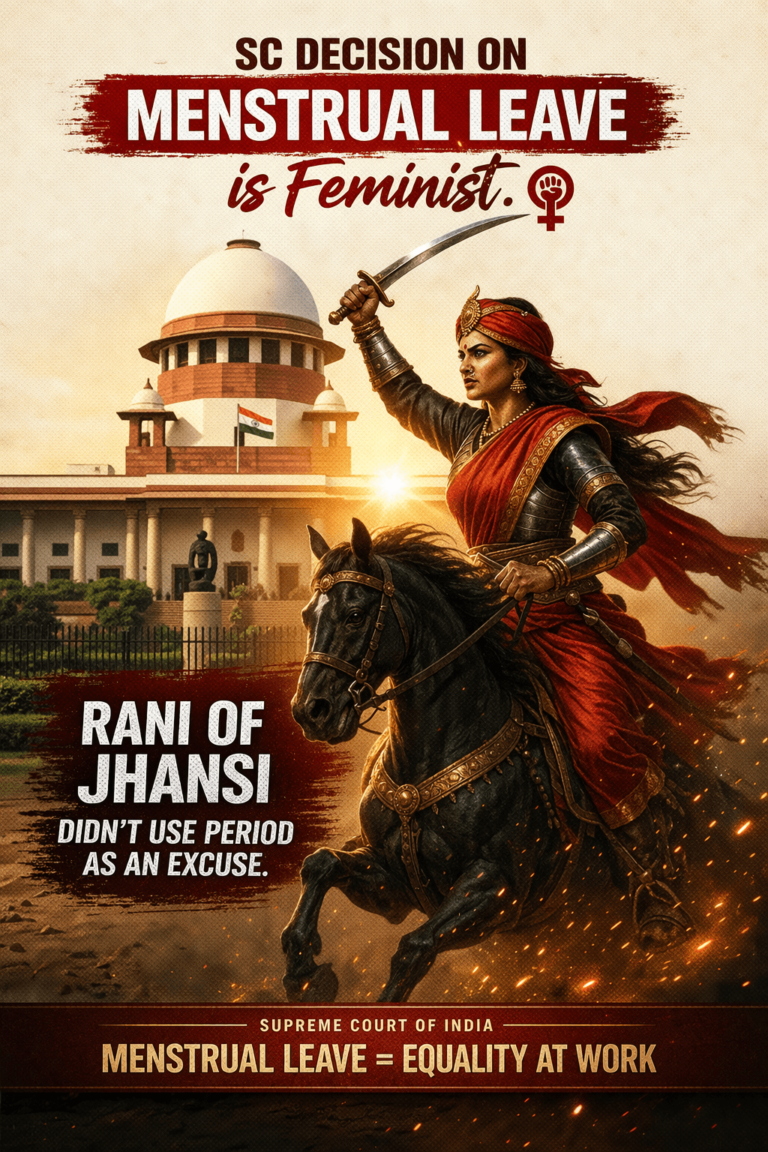
In recent debates around menstrual leave, the question is no longer just about policy it is about the meaning of feminism itself. When courts and institutions weigh in on such issues, they are not merely addressing workplace comfort; they are shaping the broader narrative of equality, capability, and identity.
At the center of this discussion stands a powerful contrast. On one hand, modern arguments emphasize the biological realities women face and the need for institutional support. On the other, history offers figures like Rani Lakshmibai, who symbolize resilience, strength, and an unyielding sense of duty even in the face of immense physical and social challenges.
This contrast raises an uncomfortable but important question: does providing special provisions like menstrual leave strengthen the feminist cause, or does it risk reinforcing the very differences feminism has long tried to overcome?
Supporters of menstrual leave argue that equality does not mean ignoring biological differences. Instead, they believe true fairness lies in acknowledging these realities and creating systems that accommodate them. From this perspective, such policies are not privileges but necessary steps toward inclusive workplaces where women can perform at their best without being penalized for natural processes.
What you need to know?
India's Supreme Court has mainstreamed menstruation, recognizing it as integral to the right to life and education. However, it rejected mandatory menstrual leave, arguing it could harm women's employability and equality. The author supports this "feminist judgment," advocating for normalizing menstruation, removing taboos, and promoting sustainable hygiene solutions instead of special entitlements.
Menstruation was a taboo subject when I was growing up. And as I got older, I realised that the topic of menstruation was off the table even among girlfriends. The secrecy and shame that surrounded this monthly event were a fact of life. Post-2014, the BJP did bring about some social change when the PM Modi-led government launched “Beti Bachao Beti Padhao”, and conversations around toilets, menstrual hygiene, sanitation, sanitary pads, etc were brought to the mainstream.
The Right Decisions
“A period should end a sentence, not a girl’s education”—these words, attributed to Melissa Berton, American activist and founder of The Pad Project, were used by Justice JB Pardiwala and Justice R Mahadevan to preface their 30 January judgment on menstruation facilities for school-going children. Menstruation is a fact of life, which is responsible for continuing life itself, so there is no need for shame.
It was heartening to note that the Supreme Court held that menstrual health is an aspect of the right to life and the right to free and compulsory education under Article 21 and 21A, respectively.
There were three key points to the ruling of Justices Pardiwala and Mahadevan. 1) Under Article 21, Menstrual health and hygiene are integral to the Right to Life and Dignity. 2) As per Article 21A, the paucity of menstrual health facilities acts as a barrier to girls’ education. 3) The State is obligated to remove all biological and social obstacles to the girl child accessing education.
This ruling by the SC will have far-reaching implications for the menstrual health landscape in India. Primarily, the taboo around the ‘M’ word is gradually eroding. At the women’s health event at the UN HQ in Delhi, it was gratifying to hear the observation of foreign visitors that there are menstrual pad vending machines in airports and railway stations, something they haven’t really observed in other countries. This indicates that menstrual hygiene is publicly acknowledged, and the country’s social progress is visible to the outside world.
Nothing Special
In Puttuswamy vs Union of India, Justice Chandrachud had observed that privacy is the constitutional core of human dignity. The judgment explains that the Constitution protects the autonomy, bodily integrity and personal choice of an individual, all of which were essential for living a life with dignity.
The SC further extended this principle in Dr Jaya Thakur vs Union of India to protect the dignity of women and children, recognising the right of access to menstrual health products and facilities as necessary for women and girls to live with dignity and to exercise their rights to education and health. This recognition of privacy as an intrinsic part of living with dignity has enabled the court to extend everyday protection to everyday realities of women’s lives.
In the landmark case of Babita Puniya, in which I represented the women in the armed forces, I humbly submitted that women officers have already proved their capability in the Armed Forces. Denying them permanent commission is both unjust and unconstitutional.
Women officers in the forces routinely manage the physiological realities of menstruation while carrying on demanding duties in the field and in operations. Making menstrual leave mandatory would be two steps backwards for these resilient women officers.
Then there are women sportspersons. Indian Women’s Cricket is now as elite as Men’s cricket. It is hardly possible for the key players to take four days off every month, especially in the middle of crucial international competitions. “We push through because we love the game and we play for our country,” said Jemimah Rodrigues, who reveals that menstruation drains energy, tests mental strength and obviously affects performance. But the women still go out on the field and play.
A Feminist Judgement
“The moment you say it is compulsory in law, nobody will give them jobs,” the bench observed in the judgment.
I call this a feminist judgment; it is the feminist constitution of this country that recognises affirmative action in the constitution.
Menstruation is an age-old phenomenon. Women have worked in fields and run their families effectively with resilience and dignity, even while menstruating.
Suddenly becoming unequal when you attain adolescence, even though this is a completely natural process, is unacceptable. During adolescence or puberty, both male and female bodies undergo changes which should be accepted as naturally as possible without attaching any shame to them.
It is the taboo and the shame that we need to get rid of. There is no natural acceptance of menstruation, and that is the malady that women are battling. Normalising menstruation is the right step toward menstrual justice. Progressive movies like Pad Man (2018) are setting the groundwork for breaking these stigmas. NGOs are working relentlessly toward eliminating the taboos around periods.
Of course, women battling severe period pain should be able to take leave as an exception rather than the norm. I do wish to bring focus on the health challenges of women who may suffer pain and go through emotional distress during periods. It demands greater scientific understanding and awareness about the psychological, nutritional and physical health of women, which may require medical attention and support in those situations.
While difficulties faced by any woman have to be resolved, we cannot make it look like entitlement in our struggle for equality.
“The moment you say it is compulsory in law, nobody will give them jobs,” the bench observed in the judgment.
I call this a feminist judgment; it is the feminist constitution of this country that recognises affirmative action in the constitution.
Menstruation is an age-old phenomenon. Women have worked in fields and run their families effectively with resilience and dignity, even while menstruating.
Suddenly becoming unequal when you attain adolescence, even though this is a completely natural process, is unacceptable. During adolescence or puberty, both male and female bodies undergo changes which should be accepted as naturally as possible without attaching any shame to them.
It is the taboo and the shame that we need to get rid of. There is no natural acceptance of menstruation, and that is the malady that women are battling. Normalising menstruation is the right step toward menstrual justice. Progressive movies like Pad Man (2018) are setting the groundwork for breaking these stigmas. NGOs are working relentlessly toward eliminating the taboos around periods.
India is a land where we worship the menstruating Goddess, Kamakhya Devi. The Ambu Bachi mela celebrates the cycle of the Goddess, which symbolises fertility and cosmic renewal. Such celebratory traditions reveal that the biological and physiological rhythms of the cycles of women have a regenerative power.
Feminism today stands at a crossroads. Is its goal to ensure identical treatment, or to guarantee equitable outcomes? Should empowerment mean expecting the same standards from everyone, or recognizing differences and adjusting accordingly?
The answer may not lie at either extreme. A mature and evolving society must find a balance—one that respects biological realities without allowing them to become barriers, and one that promotes strength without dismissing genuine needs.
Ultimately, the debate over menstrual leave is not just about a few days off work. It is about how we define strength, fairness, and equality in a modern world. And perhaps the real challenge is not choosing between resilience and support but learning how to uphold both without undermining either.